
Did you know that when a mix sounds powerful and balanced at conversation level, it will sound massive at live venues, festivals, and clubs? The Fletcher-Munson curve shows that our ears are most sensitive to mid-range frequencies (approximately 1–5 kHz) and less sensitive to very low or high frequencies, particularly at lower volumes.
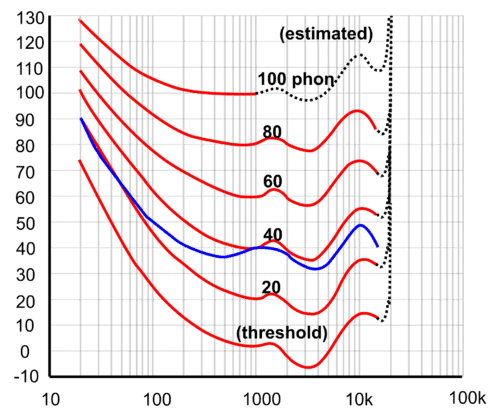
But what should you do with this information? Well, today, we’ll flip your “crank up the volume” mentality on its head and dive into the science of low-level monitoring to preserve ear health and enhance tonal balance in your mixes.
The Deception of Decibels
Most producers instinctively reach for the volume knob when a mix isn’t “hitting” right. It is a natural reaction because human hearing sensitivity changes based on sound pressure levels. When you blast music at 85dB or higher, the frequency response of your ears flattens out. The bass sounds thicker and the highs sound crisper simply because of the volume.
But watch out, as this is a trap. When you mix loud, everything sounds good. You are effectively applying a temporary EQ curve to your hearing that deceives your judgment. The real danger lies in the quiet. When you drop the volume to 60dB, your ears lose sensitivity to sub-bass and ultra-high frequencies. This exposes the naked truth of your mid-range.
The Mid-Range Microscope
The mid-range is where the most critical elements of modern music live. The vocal intelligibility, the crack of the snare, and the body of the guitars or synths all reside between 300Hz and 3kHz.
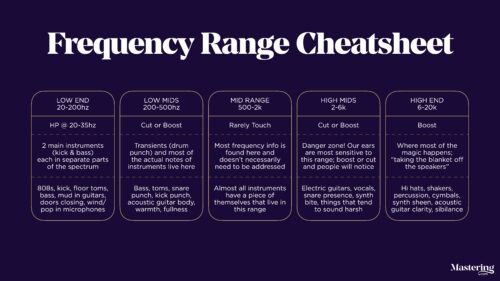
When you monitor at conversation levels, you are forced to balance these elements perfectly because they are the only things you can hear clearly. If you can get the vocal to sit right against the snare at 60dB, that relationship will hold up anywhere. You are essentially using your biology as a magnifying glass for the most important frequencies in the mix.
Solving the Low-End Paradox
You might be thinking: “If I can’t hear the bass at 60dB, how do I mix it?”
Well, since you cannot rely on the physical sensation of air bouncing you around in the room, you have to rely on the harmonic content of the bass. If your 808 or bass guitar disappears completely at low volume, it means it lacks mid-range harmonics.
To fix this at 60dB, you might add saturation or parallel distortion rather than reaching for a low-shelf boost (more on how to do that here). This ensures your low-end translates to smaller speakers like phones and laptops. If you can distinguish the pitch of the bass at a whisper volume, it is going to sound huge on a club system.
The S.O.F.T. Protocol
To integrate this into your workflow without losing the “vibe” of the session, try using the S.O.F.T. method. This approach ensures you spend the majority of your time in the safe zone while still checking for impact.
-
Set your baseline: Use an SPL meter app on your phone to calibrate your listening position. Aim for 55dB to 65dB (conversation level). It will feel uncomfortably quiet at first, and that’s okay.
-
Optimize the mids: perform your static fader balance here. If the vocal feels buried now, it is buried. Nudge the faders until the groove feels coherent without the support of loud volume.
-
Fill the spectrum: Focus on the elements that vanished. Use saturation on bass elements to bring them back into perception and adjust the volume or EQ of other elements that lost their space in the mix.
-
Test the extremes: Once every 30 to 60 minutes, turn the volume up loud (like 85dB for example) for no more than 60 seconds. This is your “club check” to ensure the physical impact is there, and the highs aren’t harsh. Then, immediately return to your baseline set in the first step.
The Takeaway
Mixing is a marathon, not a sprint. By keeping your levels low, you eliminate ear fatigue and gain hours of objective decision-making time. 60dB is the ultimate truth-teller. If you can make a track bang at the level of a quiet conversation, you have built a mix that will translate flawlessly to the real world.