
Getting mixing, mastering, and music production clients is not about one viral post or one lucky DM. It is about building a repeatable system that creates trust, filters out bad fits, and turns great projects into more great projects.
Independent artists have more options than ever: AI tools, marketplace sites, local studios, and engineers with impressive credits.
To help you stand out against this vast array of competition, I’ve created a complete inbound and outbound playbook, tailored to mixing, mastering, and production work, with practical steps, scripts, and examples you can apply immediately.
Over the next two weeks, I will help you create an offer that is easy to understand, provide proof that is easy to convey, and build a process that is easy to start. When implementing this guide, clients will understand why you’re the safest path to a release they are proud of.
The client engine: inbound, outbound, and delivery working together
Most engineers treat inbound and outbound as separate paths, but in reality, they feed each other. Here’s why:
- Inbound marketing is when artists find you first (through your content, portfolio, website, referrals, or search) and reach out, already considering you to be a good fit for their project.
- Outbound marketing is when you start the conversation (through DMs, emails, networking, or targeted outreach), so you can create opportunities with the right artists instead of waiting to be discovered.
- Delivery is when you knock a project out of the park and exceed expectations by going the extra mile. This is what converts a project into referrals, testimonials, repeat work, and portfolio clips.
If your delivery is strong, outbound becomes easier because you can confidently offer outcomes. If your inbound assets (like your social media content, portfolio, testimonials, etc.) are strong, outbound converts faster because prospects can self-qualify if they think you’re trustworthy.
A strong foundation
Before we can jump into inbound and outbound marketing, we first have to work on your positioning and delivery. So this week, I’ll help you build a strong foundation for your music production or mixing and mastering business.
Define an offer that artists can easily understand
To help artists buy our services we first need to help them understand why they should even consider us. But before we can do that, we need to understand what artists are looking for in a producer or engineer.
Most artists are not shopping for an engineer with loads of plugins, expensive analog gear, or a vague “pro sound.” They are buying an experience, with implied professional sounding results. It is our job to convey that we can give them a good experience and outstanding results by presenting them a strong offer.
A strong offer has three parts:
- Who it is for.
- What outcome you deliver.
- How the process works.
Examples that sell:
- Mixing for modern indie pop artists who want vocals forward and radio-clean, without losing edge.
- Mastering for techno and club tracks that need loudness and punch while staying clean on streaming.
- Additional production, mixing, and mastering for singer-songwriters who have great demos but need a release-ready record.
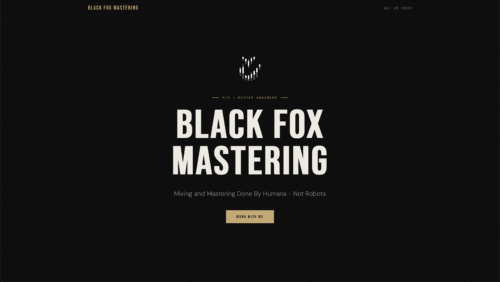
Productize your services
Once you have your offer clear, you probably have multiple services within your offer. You want to productize these services in order to market them better. Think about it, if every project is custom, it is hard for prospects to understand what to buy.
Of course, you can still do custom work, but leading with packages helps your marketing. If anything, having packages and offering an artist a custom deal will make them feel more special!
Here are two productized offers that work well in 2026:
- The Mix + Master Bundle
- For a single fee, you do both the mix and the master for this client.
- Perfect for artists who want one point of contact.
- The Release-Ready Song Finishing Offer
- A single fee for everything from vocal comping, editing, tuning, cleanup, additional production, to the final mix and master.
- Artists love to self-produce without the technical overwhelm. They bring the demo, you take it over the finish line.
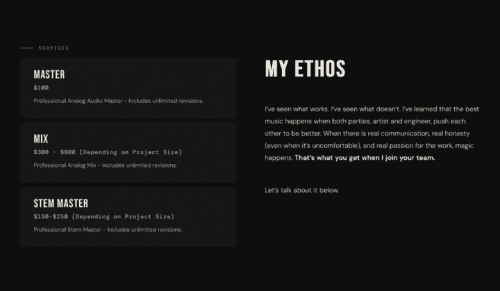
Brand identity that attracts the right clients
Moving on to your brand identity. In 2026, brand identity is not just a logo; it is the promise you keep consistently.
A strong engineering brand is built on:
- A clear niche.
- A reliable process.
- A recognizable way you communicate.
Practical brand choices that help you get hired:
- Ideally pick one genre or sub-genre where your ear is strongest, and stick to it.
- Use consistent language across your bio, website, and proposals.
- Use consistent visuals so people recognize you quickly.
- Make your values obvious: fast communication, honest feedback, no ego, extensive collaboration, etc.
If you do not want to be a personal brand, you can lean into the “studio brand” energy: calm, professional, results-focused.
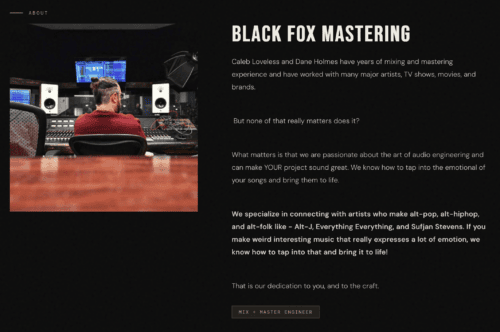
Outline your positioning on your website
While most clients will come through social media nowadays (more on that next week), websites are still important for search engines and word-of-mouth referrals. So now that we’ve got your positioning dialled in, let’s wrap it all up nicely on your website.
Here is what should be on your website:
- Lead with the offer
- Above the fold (what people see before scrolling): who you help and how you help them.
- A clear button: “Book a session,” “Request a quote,” or “Send a track.”
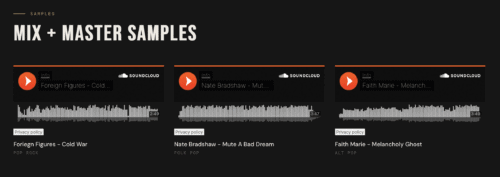
- Add an audio portfolio that is easy to skim
- 5 to 10 clips are enough.
- Label them: genre, role (mix, master, production), and a one-line outcome.
- Show your process in 3 steps
- Step 1: Onboarding to set goals, share files, and references.
- Step 2: First pass delivered in X days.
- Step 3: Revisions and final delivery.
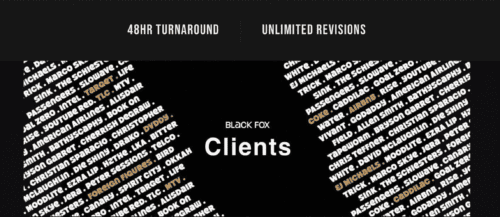
- Put social proof where it matters
- Quotes/testimonials from clients.
- Short case studies.
- Credits and results.
- Answer the questions that stop people from buying
- Pricing range.
- Turnaround times.
- Revision limits.
- What you need from them (multi-tracks, references, etc.).
- File delivery formats (main, clean, instrumental, karaoke version/TV mix, stems, etc.).
Capture proof without being awkward
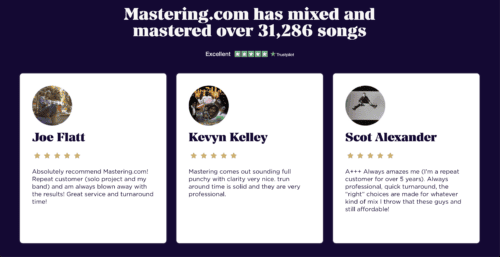
Before we move on, we need to talk a little bit more in-depth about testimonials and how to capture them. Most of our students HATE asking for referrals at the end of a project, and that’s a shame. Having a couple of great testimonials on your website is an amazing way to convert potential clients who are unsure about you.
While it’s totally normal to ask a client for one or two sentences about their experience with you after a project, you might not even need to do that. More often than not, a client will have written you a testimonial already before you even notice.
When a client replies to the final mix or master, and they say something positive, that’s a testimonial right there! Just ask them if it would be all right for you to use it as a testimonial on your website.
Deliver like a professional, then turn delivery into marketing assets
I already hinted at it many times before, but it’s finally time to work on your delivery. Cause while great marketing can get your first project, great delivery will get you the next ten.
Here is a simple delivery system that makes you stand out:
- Onboarding
- Perform an intake over the phone or video call: Go through their goals, references, deadline, etc.
- Confirm what is included: Revisions, deliverables, turnaround time, etc.
- Communication
- Establish one main channel for communication: E-mail, WhatsApp, etc.
- Set expectations: “I send an update when I start, when I deliver V1, and after each revision.”
- Version control
- Name files clearly: “Artist – Song Title (Mix V1, V2, Final, etc.)”.
- Always include mix notes: Mention what changed, what you want them to listen for, etc.
- Deliverables
- Mix and Mastered clean and explicit version.
- Instrumental version.
- TV mix / Karaoke version.
- Stems.
This is where you show why you charge a premium. You take care of them like a 5-star hotel!
Closing takeaway
To get mixing, mastering, and music production clients in 2026, you will need to build a system. Define a clear offer, build a clear brand, lead with proof of your process, and deliver an experience that artists want to talk about. The moment your work sounds great and working with you feels easy, your client pipeline stops being a mystery.
Next week, I’ll cover inbound and outbound marketing strategies specifically for music producers and mixing/mastering engineers. In the meantime, look out for an announcement email coming tomorrow about a brand new 6-week intensive for those who want to make a part-time or full-time income from freelance mixing, mastering, or producing. I can’t wait to share more details!